
Chapter 6 – Rigger/Slinger Requirements
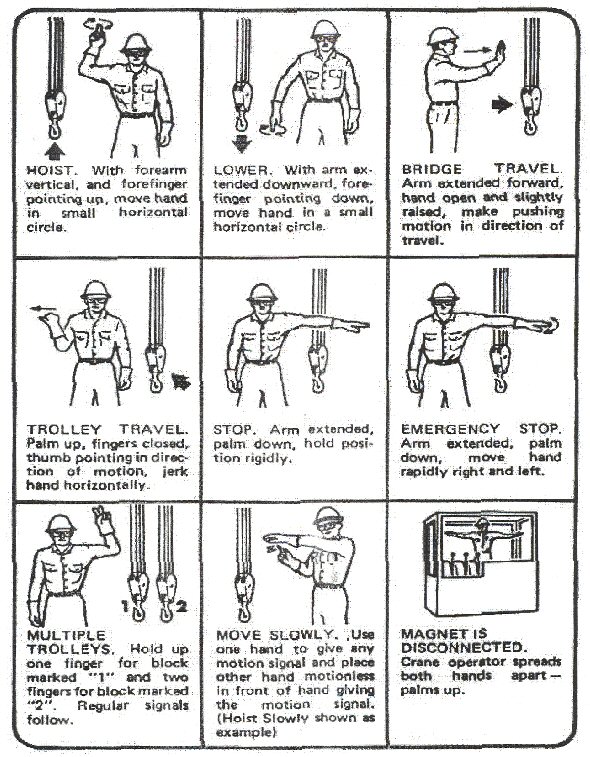
Standard Hand Signals
Rigger/Slinger Requirements
A rigger is someone who is:
- a competent person because of their knowledge, training and experience in organizing work and it’s performance.
- is capable of handling all types of slings or attachments within their department in a safe manner.
- is experienced in visual inspections on these attachments and knows the hand signals for the crane if required.
- must also be familiar with the Act and Regulations governing this equipment in the workplace.
No person should be used as a rigger or slinger unless they possess the knowledge and follow the company rules and procedures:
- Riggers must be capable of inspecting slings, attachments etc. before and after operation in the workplace.
- Any piece of equipment that is suspect must not be used until it has been properly approved.
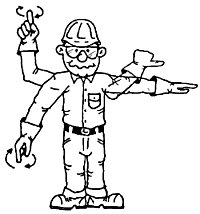
- They must also be familiar with any hand signals required to communicate their intentions to the crane operator effectively and precisely. The standard hand signals were shown on the previous page.
-
They must determine the correct lifting equipment based upon the weight of the load
Criteria for Sling Selection
Basic information to be assessed by the rigger.
1. The weight of the load
2. The dimensions of the load
3. Ambient conditions are: (Heat, gas atmosphere, sharp edges, etc)
4. Form of rigging (choker, basket, existing engineered lifting bails)We know the angle created will affect the capacity of the sling, therefore; we will assess all the information in it’s entirety to make the proper selection. Conditions such as sharp corners and environment will also be considered. If so, padding will be required to protect the sling from damage or damage to the material being lifted.
5. They must know how to perform the following, should they be required to do so:
a. Able to rotate loads without damage to the material, people or equipment in the surrounding area.
b. Determine the weight of the load they are about to lift.
c. Determine the center of gravity point for lifting.
d. Choose the correct slings, based on capacity, sharpness of load edges.
e. Be aware of the effects of sling angles and the load factor change.
f. Use of sling, double, triple and quad chain, wire rope or synthetic sling sets.
g. Use of all attachments within their department ie:
-
- Plate Clamps (C-clamp, vertical and horizontal clamps)
- Scrap magnets
- Three, four or seven magnet beam sets
- Sheet lifter
- Spreader beams
- Equalizer beams
- C-hook. etc
6. No piece of equipment should be used above its capacity rating.
7. No slings must be used below an angle of 30 degrees
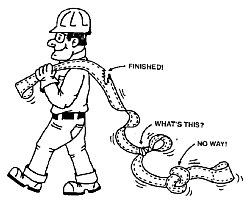 8. Slingers must never twist, tie, knot or use materials to shorten slings. Proper length slings shall be used only.
9. Slingers must not splice broken slings, these must be discarded and destroyed.
10. When slinging a load, protection will be used at the corners where the sling is in danger of being damaged by sharp edges, or possible damage to the product being lifted.
11. Care should be taken to ensure that all debris is lifted off the top of the load before giving the signal to lift.
12. Only the slinger in charge of the lift has the authority to give signals to the crane operator. The only exception would be a stop signal given by anyone who sees a problem with the lift.
13. Care must be taken when lifting boxes that have flimsy sides, in ratio to the weight of the load inside. This may result in the sides of the box being pulled off the base. Use of a basket hitch is required where possible, to prevent this condition from occurring.
14. Once a load is rigged properly, the slinger will only lift the heavy load a few inches from the floor to ensure the brakes can hold the weight, before signalling the crane operator to travel.
15. Before the load is lifted to the travel height, the slinger will ensure it is properly balanced.
16. When traveling with a load, the slinger will walk in front to warn others of it’s approach.
 17. Any load that is in danger of rotating while being transported will have a guideline attached to it to prevent it from rotating and hitting other items or people.
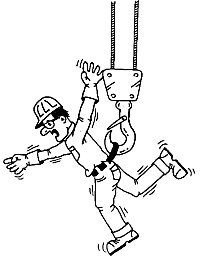
18. No person or item must ride on a load for any reason at any time.
19. No person will be allowed to ride on the hook, attachments or slings of a crane.
20. No loads will be guided over any person working in the area where the crane operates.
21. No person will be allowed to work under a suspended load without proper support being in place.
22. Gloves must be worn when engaged in rigging loads to the crane.
23. If rotation of a load is necessary, proper care must be taken to prevent the rigger or workers from becoming injured.
24. When lifting a load, it may be necessary to cradle the slings to prevent them from slippage. Extreme care should be taken so that gloves are not caught in the process. Fingers can be pinched or removed when performing this maneuver.
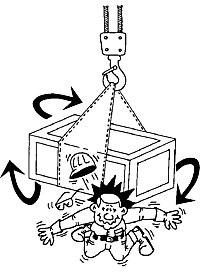 25. Before lifting a load, warn pedestrians in the immediate area.
26. Once equipment becomes stretched, cracked, broken or otherwise worn, it SHALL be destroyed.
27. Slings that have kinks, creases, or broken wires shall be taken to maintenance for destruction.
28. Never attempt to pull or push a load into position, have the crane operator spot the load for you.
29. Slings SHALL NEVER be pulled from under a load by a crane. If possible, sit the load down on blocking.
30. Slings will be placed on the bullring when not in use. This will prevent someone from being injured.
31. Never drag slings across the floor to the next lift. After use, slings, attachments or detachable items must be inspected then stored in their proper place.
32. When using plate clamps, make sure you select the proper clamp with opening adjustment suitable to the plate to be lifted. Never use one with a minimum adjustment larger than the thickness of material to be lifted. Do not use shims, they have a tendency to fall out.
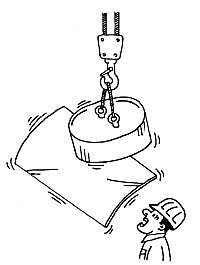 33. Use a spreader beam when the load is long and flexible, it should be equipped with multiple plate clamps to ensure the load is balanced and will not bend at the center.
34. Sheets to be lifted should be balanced and secure before a lift is performed when using a sheet lifter.
35. Loads should be lifted only a minimal height to ensure the load is secure before lifting to the travel height when using plate clamps.
36. Magnets should be centered to ensure a balanced load, especially long loads. Additional stresses caused by a non centered load may cause the load to peel off the magnet and drop.
People with pacemakers should avoid being in the area where magnets are being used.
37. The surfaces of the loads to be lifted should be smooth and free from surface rusting, oil and loose dirt. When the object to be lifted is not flat, the magnet should be de-rated by at least 50%.
38. The magnetic force is reduced when passing through a thin object. Picking up several thin sheets at one time is hazardous. Exercise extreme caution as objects on the bottom will have a tendency to drop.
39. Magnets will heat with constant usage, this will reduce their ability to perform properly. Magnets should be set on a raised surface to allow the magnet to cool. Most magnets are easily detachable and should be stored in a clean dry place that is intended for that purpose.
40. Operators should use a tether to prevent loads from rotating. Loads should never be raised any more than absolutely required to complete the task.
41. Riggers/Slingers SHALL NOT do the following:
- Never Use any lifting device that is unsafe.
- Never Lift a load suddenly
- Never Cause shock loading by lifting a load suddenly. Shock loading will result in severe stress to the slings and equipment. A sudden drop of 12″ will double the weight seen by the equipment.
- Never Overload the slings, attachments and crane etc.
- Never Use the point of a hook to lift any load. This is called point loading. This can cause the hook to stretch or the load to drop.
- Never Use any object to hammer a sling onto the hook.
- Never Use rigging over sharp corners without sufficient packing to prevent damage.
- Never Shorten a sling by tying knots or using any foreign materials.
- Never Carry an unbalanced load off by more than 5 degrees from the horizontal plane.
- Never Use an angle of less than 30 degrees off the horizontal plane.
- Never Assume that the load is safe to lift without checking.
42. Always inspect the sling or attachment before and/or after use.
| RIGGERS/SLINGERS ARE RESPONSIBLE TO CHECK THE LOAD. SAFETY IS EVERYONE’S RESPONSIBILITY. |
Rigging Loads onto Cranes
A slinger is a competent person whose job requires them to sling materials, components and assemblies, properly and safely using all types of slings and hook-ups. A slinger is also required to make visual inspections of the lifting sling(s), perform all slinging tasks within a department and be knowledgeable with the Provincial safety regulations.
a.) No worker shall become qualified as a slinger unless they are fully conversant with rules and procedures of critical lifts.
b.) All signals shall be clear and easily understood between the operator and the slinger(s).
c.) A slinger is responsible for teh safe hitching of the load. The slinger is the only one to communicate signals to the crane operator, except the stop signal.
d.) The slinger shall determine the weight of the load by doing the calculation. The capacities of sling attachments and crane shall not be exceeded.
e.) The proper sling shall be chosen for each job by the slinger. The slinger shall be thoroughly familiar with the safe capacities of the slings.
REMINDER: Decreasing the angle between the sling and the horizontal increases the stress on each leg of the sling, consequently, the angle should never be less than 30 degrees. This applies to all slings. It is recommended that you use a 45 degree angle as a minimum angle from the horizontal plane.
f.) Before and after each lift, a visual inspection of each item shall be performed.
g.) Slings with the proper length only, shall be used.
h.) Broken slings shall not be used and will be destroyed immediately.
i.) Proper protection shall be used, where applicable, to provide protection to slings from damage by sharp edges and protect machined surfaces from damage by the sling and/or attachment.
j.) All loads before lifting shall be free of loose materials.
k.) The slinger will determine and ensure the weight of the load before a lift is performed. * Whenever possible, slings shall be placed around the bottom of the boxes.
 l.) Gloves shall be worn by employees involved in rigging loads to hoists or cranes.
m.) NOBODY IS PERMITTED TO STAND OR PASS UNDER A SUSPENDED LOAD
n.) It may be necessary to steady the slings while slack is being taken out. Care shall be taken so that hands and fingers do not get caught. Step away at a safe distance before the lift is performed.
o.) Before the lift, warn employees to stand clear of the “Primary Danger Zone“.
p.) Never “push or pull” loads.
q.) Slings and hooks shall not be dragged on the floor. Avoid pulling slings from under loads.
r.) Slings shall be stored in their designated area when not in use.
s.) NEVER:
(i) Shockload
(ii) Use a sling that is damaged or unsafe
(iii) Carry a load on the hook point or insert the hook tip in a link of a chain.
(iv) Hammer a sling into place
(v) Fasten a sling over sharp corners without protection.
(vi) Cross, kink, twist or tie a knot into a sling
(vii) Carry an unbalanced load
(viii) Overload a sling, hoist or crane
t.) The slinger is responsible for the use and condition of all slinging accessories. The fact that the maintenance personnel inspects all slings shall not relieve the slinger of this responsibility.
u.) The primary responsibility of the slinger is SAFETY, for him/herself and the fellow employees working near the danger zone.
When using a four legged sling we must base the capacity on it’s ability to support the load on any two sling legs because:
- The length of any one leg may be shorter or longer (even by a tiny fraction) than the other.
- There may be a variance in the height of any lifting accessory in any corner.
- The item being lifted may not be perfectly true and may have a variance in height in any corner. Any variance in any corner will cause only 2 slings to carry the load and the other two will be used to balance the load.
The proper use of a four legged Bridal Sling
In the selection of a four leg bridal sling, we will consider the load will be distributed over two legs rather than all four.
Because:
1) There is no practical way to determine the exact length of each leg.-If any of the legs were to be longer or shorter than the others, the actual load would be lift by two legs rather that all four.
2) If the sling legs were to be attached to fixed lifting points (Lifting bales)Likewise, the exact height of these bails may vary slightly. In which case, again, the load would be distrusted over two lifting points on the
sling.
3) If the load itself is not absolutely straight and true. Any corner were higher or lower than the others, the load again would be distributed to two legs rather than four.
The variation in sling application need only be slight, Such that a person would typically not be able to visually determine the difference of the variation.
Therefore we will always consider the load to be lifted from two points rather than four points.
For Example
If we were to consider the load to be 1,000 lbs, then the minimum capacity sling that could be used would be a 2,000 lbs sling plus any additional load that may be presented by the angle at which the sling leg is being used.
Do not underestimate the danger posed by seemingly minor damage. A consistent line mark from one side/end to the other, can reduce the strength of an affected component or device by 60% or more.
Introduction to Slings and Rigging
There are three basic types of material used for rigging materials to hoists and cranes.
Chain Slings
Man Made Fiber Slings
Wire Rope Slings
Synthetic Slings
Each of these has unique qualities that makes them ideal for certain application and situations.
Chain Slings
Why Select: Most durable of all slings
Why Not Select: Not user friendly and high cost
Man Made Fiber Slings
Why select: Most user friendly
Why Not Select: Fragile
Wire Rope Slings
Why Select: Cheap
Why Not Select: Very limited use.
Synthetic Slings
Why Select: Synthetic slings are the most user friendly of all the slings. In addition they are very versatile and economical.
Why Not Select: They are delicate and require special care. Such as protection from sharp edges, heat and chemicals to name a few
Planning is a critical element for a rigger/slinger
The most common problem associated with rigging is the availability of the right sling at the location for the lifting application and the inability for the rigger to wait until the correct sling arrives.
Substitution of a sling by inferior or damaged slings is a severe safety violation. The consequences of such actions need to be seriously considered and the action rejected.
Synyhetic slings are the most user friendly of all the slings. In addition they are very versitial and economical.