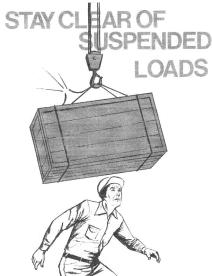
Chapter 4 – Load Handling Using Overhead Cranes
General Rules and Qualifications
General Rules
(a) Cranes shall not be operated by an operator that is not feeling physically fit.
(b) Only employees who have been trained, certified and authorized by supervision are permitted to operate hoists and cranes.
(c) Hoist and crane operators shall be instructed in the proper use and handling of portable fire fighting equipment.
(d) Find out where the disconnect switch is located.
Qualifications
Crane operation, to be safe and efficient, requires skill, the exercise of extreme care and good judgement, alertness and concentration, and a rigid adherence to proven safety rules and practices.
In general practice, no person should be permitted to operate a crane:
(a) Who cannot speak the appropriate language or read and understand the printed instructions
(b) Who is not of legal age to operate this type of equipment.
(c) Whose hearing or vision is impaired. (Unless suitably corrected, with good depth perception.)
(d) Who may be suffering from heart or other ailments which might cause interference with the operator’s safe performance.
(e) Unless the operator has been properly instructed.
(f) Unless the operator has demonstrated his/her ability through practical operation, and has a thorough knowledge of the Act and Regulations, and company rules.
(g) Unless the operator is familiar with rigging techniques, (where applicable) and understands the principles of the various attachments. Knows and understands the required hand signals for lifting and lowering down loads.
Procedures for Proper Crane Operation
Cranes shall be operated by the following personnel:
- Competent (certified) crane operators.
- New Operators under the direct supervision of a certified operator.
- A certified crane repairman.
- A certified crane inspector.
Definition of a Crane Operator
A competent person who, because of his/her training, knowledge and experience, meets or exceeds the qualification of a crane operator. Is able to lift, lower, turn, transport, rotate, and position loads, use attachments, main hook, auxiliary hook, to transport material, articles or things in a safe manner, and is familiar with the Act and the Regulations.
There is no such thing as a part time operator. Every crane operator must be trained and certified as competent.
Wirelessly Controlled Cranes
On completion of the inspection of the control pendant, the operator must sound the horn/alarm before attempting any movement of the crane. This is done to assure the operator he has the appropriate control of the crane he intends to use.
The operator must insure that he has the proper landing area and that all personnel is clear before attempting to place or remove the load.
Wireless controls allow free and unhindered operator movement that can lead to some inherent concerns.
a. The operator must position himself close enough for a clear view of the lift and at the same time maintain the appropriate distance to avoid a problem should the load shift.
b. In the event of unforeseen load movement, the operator must ensure that he or others are not blocked or locked into an inescapable position.
This control should be looked over and returned to it’s proper storage area when not in use. If the unit has received some damage, it should be turned into the supervisor or maintenance for repair.
Operating Procedures for Cab Operated Cranes
Items 1-5 May be skipped if not appropriate for the student.
1. Cab Operated:
Crane operators shall enter or leave crane only at designated areas. Steps and ladders from platforms should be used. Do not leave the crane by climbing onto another crane adjacent to yours.
Do not carry anything in your hands, if you are climbing or descending a ladder. Place articles into your pockets, or into a basket, and haul or lower them from your crane.
2. Never close an open power switch until you have satisfied yourself, that here is nobody on or about your crane.
3. Always lock out/tag out your power switch before you go up on top the catwalk to perform your inspection. USE LOCKOUT PROCEDURES.
4. Before closing the main switch, the operator shall ensure that the controls are in the neutral position, and operate freely.
5. After the power is turned on, conduct a pre-shift inspection. (see pre-shift form)
6. Check out the limits on the crane as follows:
- Ensure that no load is on the test hook;
- Run the block up to the drum with two (2) feet, main and/or auxiliary;
- Inch the block until it stops, (if it fails to stop. Shut-off the controls).
- Lower the block two (2) feet, then proceed to raise it toward the drum in low speed.
- If it stops, then you are free to try your lower limit switch. (not all cranes are equipped with a lower limit switch).
- When the block is four (4) to six (6) inches off the floor, the low limit switch should activate, leaving at least two (2) wraps of cable on the drum.
All students should resume with the following instructions.
Do not allow the hook to hit the floor, as the cables could jump out of the sheaves and become damaged by this action.
CRANES THAT HAVE A FAULTY LIMIT SWITCH
SHALL NOT BE USED!!
7. Operators shall not use the limit switches as operating controls. Where loads are to close to the upper limit, care should be taken, or the load should be re-slung to prevent the switch from being tripped.
8. Cranes that show wear on the hoist wire rope shall not be used until they have been checked over by a competent repairman.
9. When lifting a load, care should be exercised to ensure that the load is secure, lifted on its center of gravity point, and only lifted a few inches off the ground to check the brakes holding power. If the load does not remain at the point where it was left, then have the brakes checked by a competent person. You, as the operator, are responsible for the safety of the lifts and personnel within the primary area from which you are operating, unless you are acting under instructions from an authorized signaler and cannot see the operation.
Determining the center of load can be done by calculating. most operators will center as close as possible by eye, lifting the load a few inches and shift the sling and repeat until the center is correct.
Side Pulling is Not Allowed
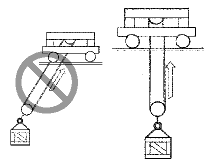
Have a forklift operation move the load under the hook
If you feel unsafe operating a load, you by law have the right to
deny performing the task, no matter what anyone tells you.
The newest cranes, technically advanced, have frequency drives that have acceleration and deceleration, preset to reduce load swing. “slow movement” These also produce a movement hesitation on activation and stop. “Push button”
Make sure that the E-Stop button is depressed “off” when the crane is not in use to prevent frying due to power surges.
10. Signals shall be taken from one (1) operator, unless it is a stop signal. Where two (2) cranes are used for one (1) lift, then only one (1) signaler will be used.
11. Never allow your load to swing when starting a lift. Always proceed with caution.
12. Never allow any person(s) to ride on the hook or load.
13. Be careful that the slings are free before lifting, and that they are not caught or kinked when taking up the slack.
14. Never exceed the lifting capacity of the crane, unless it is during a test of the system, which only competent and authorized personnel can perform.
15. Before transporting a load, the warning siren should be sounded if available, to alert ground personnel that you are proceeding to move.
16. Extreme care must be taken when you have molten metal as your load, to prevent spillage on pedestrians near your travel route.
17. Never lift a load over anyone!
18. All control movements shall be smooth and deliberate. Never jump start or stop fast.
19. When lifting loads that have more than one worker around it, ensure that they are all clear before starting the lift.
20. When traveling with the bridge or trolley, ensure you time your braking distance to prevent bumping or striking any other objects, or swinging of your load due to fast or reverse plugging.
21. When more than one (1) crane is operating in the same bay, look in the direction that you want to travel before moving, this will prevent striking the crane next to you.
22. Do not run in to runway stops. When pushing other cranes, only do when authorized.
23. When placing loads, position the load carefully, do not have anyone push or pull the load into position, this is poor practice.
24. When traveling with a load, it shall be raised high enough to clear obstructions without striking them.
25. Never leave an elevated load, when you leave your crane, always sit it down in the designated area out of the way of lift trucks or other vehicles.
26. Plugging of motors should be kept to a minimum wherever possible, use good judgement when travelling to keep this to an acceptable level.
27. Operators shall not make side pulls. Side pulling is when the load is not centered under the hoist. This activity can produce a hazardous situation due to uncontrolled movement of the load. It is also very harmful to the equipment which is not designed for this activity. Rope guides on hoist will break when this activity occurs. Posts for rope guides can vary from one to another depending on capacity of hoist. 5 Ton rope guide can cost $1000-$2000
28. Operators shall ensure that no debris or material is on top of a load before lifting.
29. Operators shall park their cranes away from aisles, populated areas or heat.
30. Operators shall read the manufacturer’s operators crane manual before use. If one is not available, the supervisor should be made aware of this and one should be obtained by the crane manufacturer.
31. Operators shall not exceed the rated capacity of their crane, attachments, chain or wire rope slings at any time.
32. Never lift an unbalanced load. (Any load over five degrees tilt.)
33. When a multi-chain set is used, have the unused hooks attached to the bullring.
34. When using magnets, do not store the load in an elevated position, and be careful of people walking under your load. Also be aware of people with pacemakers.
Cab Operated Cranes
Items 35-37 May be skipped as determined by the student
35. If the power should go off, place your controls in the neutral position. (assuming they do not automatically go into neutral.) Remain seated until the power starts up or help arrives. Do not panic.
36. When boarding a cab operated crane, ensure the boarding control is operated before you step onto the crane platform. (the red light in the cab should come on.)
37. When leaving your crane the following procedure should be followed:
- Raise all hooks to an intermediate position
- Spot the crane at a designated location.
- Ensure all controls are in a neutral position.
- Make a visual check of the cabin before you leave.
- Open boarding control before stepping off the crane. (red light should come on.)
38. When two (2) cranes are being used to lift the same load, the operators must take directions from the same rigger/slinger only. If radio contact is being used, there should be continuous communication until the operation is completed.
39. If a swing should develop during transportation, move your trolley in the same direction as the swing, after it has passed center (directly below the trolley). Ensure that you choose the direction what will not collide with any person, machines or material. Should an oval swing develop, eliminate the most dangerous one first, eg.:
- Heading towards any person
- Heading towards any equipment
- Heading towards any material
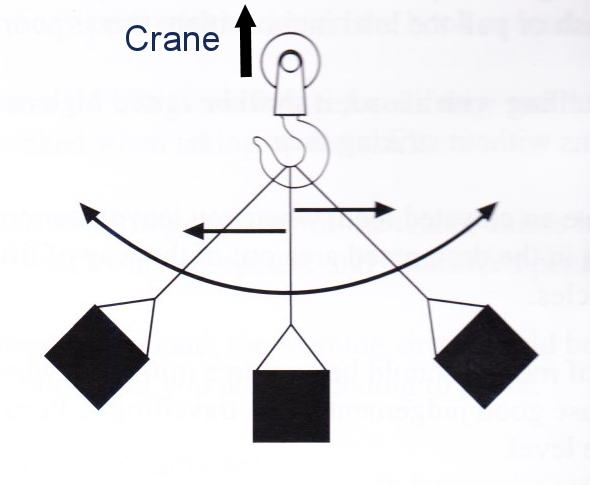
Remove by moving the crane/trolley in the direction of the swing in high speed starting from the center of the pendulum. Repeat if necessary.
Critical Application Equipment
What is Critical Application Equipment?
It is equipment that, if a failure would occur, would cause a catastrophic accident.
For example, if a forklift is pulling a second forklift with a piece of chain, and the chain broke, both forklifts would stop. If the chain did not strike anyone, there would be minimal damage and the operators would get off the forklifts and replace the chain.(OOOPPPPSSSS!!!)
BUT, if a chain is holding a load suspended and the sling broke, there is a possible chance that the damage would be severe. If the load fell and struck something, or worse someone, it would be catastrophic. (OOUUCCHH!!!)
ANYTHING that is used for overhead lifting SHALL be considered Critical Application Equipment; the runway, bridge, trolley, hoist, under hook attachments, slings, or any hardware.
IF ANY ONE ITEM FAILED, IT WOULD BE CRITICAL!!