
Chapter 2 – Occupational Health and Safety Act
An essential part of any Health & Safety program is to protect the equipment and the material being used to manufacture the finished product that is being shipped to the customer. It is the responsibility of every material-handling operator to operate equipment in accordance with established procedures and adhere to the following safety rules and regulations.
(a) Only qualified and authorized employees are permitted to operate cranes and hoists;
(b) Operating controls must be tested before operation to ensure the equipment is safe and serviceable;
(c) Operating controls must be placed in the “off” position with the brakes applied before leaving the hoist or crane;
(d) Unsafe or defective hoists, crane and below-the-hook devices must not be operated. Any defects shall be reported to the supervisor immediately!
(e) While lifting loads, keep clear from overhead loads. Stand to one side, and if necessary, use a rope to guide the load. If the load is bulky and difficult to handle, request help to guide the load safely;
(f) Standing, walking, or working under a suspended load is NOT permitted at any time. Upon entering a plant environment, scan the area for any moving or stationary lifting equipment before crossing the floor;
(g) Riding on a load or hooks is strictly prohibited;
(h) Before attempting to lift loads, even a few feet off the floor, the operator must ensure that the load is balanced;
(i) The first responsibility of the operator is to ensure that the lift is safe;
(j) Before lifting, the lifting device must be directly over the load to be lifted to avoid swinging of the load during operation. This is extremely important when lifting heavy loads such as moulds or dies!
(k) Side pulls are not permitted at anytime.
(l) Ensure that any loose objects such as tools, parts, blocking or packing materials are removed before attempting the lift;
(m) Cranes and hoists must not be used to raise or lower employees, unless the legal requirements of OHSA are met. (OHSA Regulation 52)
(n) Operators must ensure that chains or wire ropes used to lift a load are not kinked, caught against, or possible to make contact or get snagged by obstructions during travel in any direction;
(o) Slings shall not be left dangling from the load hook. Slings being carried to the load to be lifted should have the hook placed on a bullring.
Hooks should be raised high enough to ensure that they are clear from obstructions and safe from striking any employees.
(p) Hoists and cranes must not be operated if the limit switch is defective or the wire rope or slings show defects.
(q) Never use the primary upper safety limit switch to stop a hoist or crane. The movement of the load must always be under control by the operator. Limit switches are a safety precaution and shall be tested before lifting a load by slowly raising the hook block the required distance to cause the limit switch to open the circuit.
The limit switch is required to be tested every day prior to the crane operators’ shift. There shall never be any load on the hook for this test. We will raise the hook block all the way to the upper limit, engaging the limit switch in slow speed until it automatically stops.
The designer of the crane utilizes mechanical advantage for the efficiency benefit of the crane. Efficiency is achieved by reducing the weight of the crane. We are utilizing a sheave (pulley) system which reduces the size of the wire rope thereby reducing the weight of the wire rope itself. By reducing the size of the wire rope, we are able to reduce the size of the hoist drum and all of the sheaves. Due to the reduction in the size of the wire rope and the fact that we have only one wire rope coming off of the drum, each fall of the wire rope will have only a capacity divisible by the number of falls.
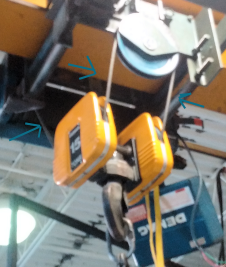
As shown in the picture we have 4 falls of wire rope (one hidden). Each fall will carry 25% of the capacity of the crane.
Only one fall comes off the drum and goes to the first sheave. The hoist motor must have instant torque and therefore generates approximately 150% crane capacity. Therefore the hoist motor has more than enough power to overcome the 25% capacity wire rope coming off the drum.
The upper limit switch is a safety device place for the protection of all workers underneath the hook and must be functioning correctly prior to use.
(r) The operator must ensure that he area is clear and free before lifting. Lifting shall begin slowly and smoothly. A signal or other warning device should be used.
(s) Reverse plugging will not be practiced. Do not move a crane or hoist in reverse until it has come to a full stop. Except to avoid an accident!
(t) Bumping into runway stops or other cranes shall be avoided.
(u) Loads shall not be raised higher than necessary to clear obstruction safely.
(v) Loads should be placed in a safe place to avoid damage. While lowering the load, the operator should proceed carefully to ensure that the load is under full control.
(w) Operators shall constantly be aware of the safety of the load being lifted, their own safety and that of their fellow workers.
The impact of a work related injury can be a major life changing event. In addition to the following one must consider how an injury will affect our day to day activities and how we will interact with our loved ones and friends.
Unfortunately injuries in the field of rigging, load handling with cranes are usually catastrophic. Extreme care and concentration to the work at hand is critical to the operators and load handlers.
Individuals that are found to be negligent in their actions and activities when lifting, rigging or handling loads will be charged and fined or imprisoned. The only defense available is that the worker did everything he could to avoid the accident.
66(1) Every person who contravenes or fails to comply with,
(a) a provision of this Act or the regulation;
(b) an order or requirement of an inspector or a Director; or
(c) an order of the minister,
is guilty of an offense and on conviction is liable to a fine of not more than $100,000 or the imprisonment for a term of not more than twelve months, or both.
66(2) If a corporation is convicted of an offense under subsection (1), the maximum fine that may be imposed upon the corporation is $1,000,000 per offense.
DEFENSE
66(3) it shall be the defense for the accused to prove that every precaution reasonable in the circumstances was taken. (DUE DILIGENCE)
WHAT IS NEGLIGENCE
I knew I should have done it but I didn’t do it.
I knew I shouldn’t have done it but I did it anyway.
The following rules are stipulating what you should or should not be doing.
Not following them constitutes negligence.
DEFINITION OF A LIFTING DEVICE
Means a device that is used to raise or lower any material or object and includes its rails and other supports but does not include to which the Elevating Devices Act applies.
REGULATIONS UNDER OHSA
Material Handling
Regulation 45 materials, articles or things,
(a) required to be lifted, carried or moved, shall be lifted, carried or moved in such a way and with such precautions and safeguards, including protective clothing, guards or other precautions as will ensure that the lifting, carrying or moving of the material, article or thing does not endanger the safety of any worker;
(b) shall be transported, placed or stored so that the material, article or things,
(i) will not tip, collapse or fall; and
(ii) can be removed or withdrawn without endangering the safety of any worker; and
(c) to be removed from a storage area, pile or rack, shall be removed in a manner that will not endanger the safety of any worker.
I. Regulation 46
Machinery, equipment or material that may tip or fall and endanger any worker shall be secured against tipping or falling.
II. Regulation 47
Cylindrical objects stored on their side shall be piled symmetrically with each unit in the bottom row choked or wedged to prevent motion.
III. Regulation 48
Barrels, drums or kegs that are piled on their ends shall have two parallel planks placed on top of each row before another row is added.
Regulation 51 (1), a lifting device shall:
(a) be so constructed, of such strength and be equipped with suitable ropes, chains, slings and other fittings so as to adequately ensure the safety of all
(b) be thoroughly examined by a competent person to determine its capacity of handling the maximum load as rated.
Formal Crane Inspection is Due
(i) prior to being used for the first time, and
(ii) thereafter as often as necessary but not less frequently than recommended by the manufacturer and in any case, at least once a year, and a permanent record shall be kept, signed by a competent person doing the examination.
(c) be plainly marked with sufficient information so as to enable the operator of the device to determine the maximum rated load that the device is capable of lifting under any operating condition;
(d) have a cab, screen, canopy guard or other adequate protection for the operator where the operator may be exposed to the hazard of falling material;
Regulation 51(2) A lifting device shall be operated,
(a) only by,
(i) a competent person, or
(ii) a worker being instructed who is accompanied by a competent person; and
(b) in such a way that,
(i) no part of the load passes over any worker.
(ii) where a worker may be endangered by the rotation or uncontrolled motion of a load, one or more guide ropes is used to prevent rotation or other uncontrolled motion, and
(iii) subject to subsection (3), when its load is in a raised position the controls are attended by an operator.
(5) Where a lifting device is equipped with limit switches, the switches shall,
(a) automatically cut off the power and apply the brake; and
(b) not be used as an operating control unless designed for such use, in which case a second limit switch shall be located behind the control limit switch.
An overhead crane should not be used to lift personnel. (CTC advice)
Elevator and Escalator Act Applies
Regulation 53 Where a traveling crane is operated on a runway, there shall be,
(a) rail stops or bumpers extending at least as high as the center of the wheels at both ends of the runway, and
(b) where applicable, similar rail stops at the ends of the crane bridge.
Regulation 56 Where the operator of a vehicle, mobile equipment crane or similar material handling equipment, or its load, shall only be operated as directed by a signaler who is a competent person and who is stationed,
(a) in full view of the operator;
(b) with a full view of the intended path of travel of the vehicle, mobile equipment, crane or similar material handling equipment and its load; and
(c) clear of the intended path of travel of the vehicle, mobile equipment, crane or similar material handling equipment and its load.
Regulation 59 Except for the purpose of a test of the material handling equipment, no material handling equipment shall be loaded in excess of its maximum rated load
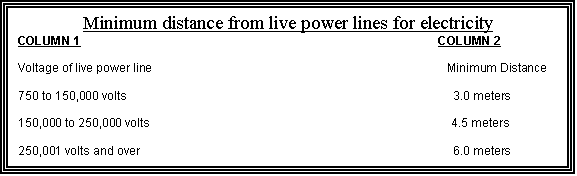
Regulation 60(2) Subject to section 42,2, where a vehicle, crane or similar equipment is operated near a live power line, and its possible for any part of the vehicle, crane or similar equipment or its load to make contact with the live power line,
(a) a worker shall be stationed within the view of the operator to warn the operator when any part of the equipment is approaching the minimum distance from the live power line; and
(b) clearance shall be allowed for any change of boom angle and for any swing of the hoisting cable and load.
WHEN WORKING NEAR ANY ELECTRICAL POWER. EXTREME CAUTION MUST BE EXERCISED. ALL EFFORTS MUST BE MADE TO DISTANCE THE LOAD AS MUCH AS POSSIBLE FROM THE POWER WITHIN THE GUIDELINES AS A MINIMUM. (CTC Advice)