Chapter 3 – Daily Preshift Inspection Copy

Daily Inspection

There are two electrical conditions that may arise, causing potential for problems. These problems can become very severe.

1. Welded Contactor – This is a condition where arcing in the electrical contactor switch causes extreme heat. A flash that could cause the two contacts to bond (weld) and not release, even when the operator releases the control button. In this case the crane trolley or hoist continues to move in spite of the operator’s release.

  • The first action shall be to depress the E-stop button which should cut the power via the main line contactor, on the bridge.
  • Should this fail, the operator must locate the disconnect switch, usually located at eye level on the power side of the crane runway.
  • You will note that the first item on your pre-shift inspection checklist is to locate the disconnect and assure it is accessible.


DO NOT OPERATE -CALL MAINTENANCE DEPARTMENT.
2. Reverse Phasing – It is a condition in which power is connected in improper order causing action to be reversed when the control button is depressed. (Hoist goes up when down down button is depressed and likewise for all other actions)
DO NOT OPERATE -CALL MAINTENANCE DEPARTMENT.
 
In Order to Verify Direction (for Reversed Phase Condition) 

If phasing is correct, and UP is pushed, the hook goes up and all is well.

If phasing is WRONG and UP is pushed, the hook will go down.
Advise maintenance and lock the crane out.

If phasing is CORRECT no problem, carry on with the work.

If phasing is WRONG, the load will go up, limit switch will fail, two blocking will occur,  the wire will snap and the hook or load will come
CRASHING DOWN!

Welded or Fused Contactor

  • A contactor is simply an electrical switch with two contact points that may (Rarely) be subject to arcing.
  • The arcing causes a severe increase in temperature to such levels that the contact points will liquefy
  • When you push the button to activate the contactor the two points will be joined, the arcing has dissipated, and they instantly cool.
  • They fuse or weld together.
  • The crane function begins as normal, but release of the control button does not stop the hoist, trolley or crane movement.
  • The crane component is no longer under your control.
  • You must activate the E stop button on your pendant
  • If that doesn’t work, then you must get to the main crane disconnect, remembering “The left hand rule” shut the power off.

Practical Crane Inspections

First determine that there is no ongoing work being done on the crane.

Determine the position of the hook and that there is NO LOAD

Determine that the crane and controls are in good general condition, no obvious signs of deterioration

If the Hook is 50% or higher to the fully raised position, after checking for reversed phasing (up motion) you may proceed toward the upper limit

Once you are in the proximity of the ULS, you must go to the slow speed, observe carefully as you approach ULS continuing until the ULS is engaged. If the limit switch is functioning correctly proceed down.

Depending on the hook height at start you may review the trolley function on your way up. And the bridge function on your way down.

Once the hook is at eye level inspect the hook, look for cracks, gouges bent hook tip or stretched tip. Rotate the hook.

Inspect the bottom block, particularly the grooves in the sheave. Then check the wire rope.

Hoist and Crane Daily Inspection

The amount of time requires may vary for individual and circumstance, but is generally accepted to be 5 to 15 minutes or so.

Each individual operator is responsible for the crane, load and activities while he is operating.

Because someone else may have checked the equipment prior to use, this shall not relieve the operator of his responsibility.

The list on the next page is a visual check and does not require any tools.

The operator shall move the crane, hoist and trolley in all directions without load to verify proper function.

The upper limit switch shall be tested WITHOUT load.

(a)   Hoists and cranes shall be inspected for loose parts, oil leaks and other defects on a daily basis before every shift.  Any defect or unsafe condition observed shall be reported to the supervisor immediately.

(b) Hoist and crane controls shall be kept clean and functional at all times and should be thoroughly tested to ensure their proper operation.

(c) All slings and ropes shall be inspected for wear and damage.  If fraying is evident, they shall be destroyed and replaced immediately.  Hooks shall be inspected for stretching ( metal fatigue) and the presence of a safety latch.

Hoist and Crane Daily Checklist

Verify the area to determine that there is no one incorrectly positioned for crane activity, if otherwise-cease activity and correct situation.
    Check sheaves for cracks, gouges and wire rope marks in the groove (corrugation). If any of these are found, stop and advise maintenance department.
    Check wire rope for fraying, loose wires, kinks, proper placement on drum, shinny spots on the surface may indicate wear. Wire rope should be lubricated with light lubricant-see section on wire rope
    Check hooks for wear and deterioration on the saddle, cracks , nicks, gouges are cause to verify with the maintenance department
    Check for:
    – stretched hook
    – bent hook tip
    – presence of a safety latch
    – rotation of hook is smooth
    – no filings on hook block
    See section on verification of limit switch
    Before lifting a load, lift it only a few inches to determine that the brakes are holding, If load drifts, call maintenance department
    Check floors for oil drippings
    All activities should be as normal. Any abnormal signs shall be reported and crane activities ceased until corrected or advised by proper authority to continue.

    The operator is responsible and will not continue if there is any concern for any workers safety.
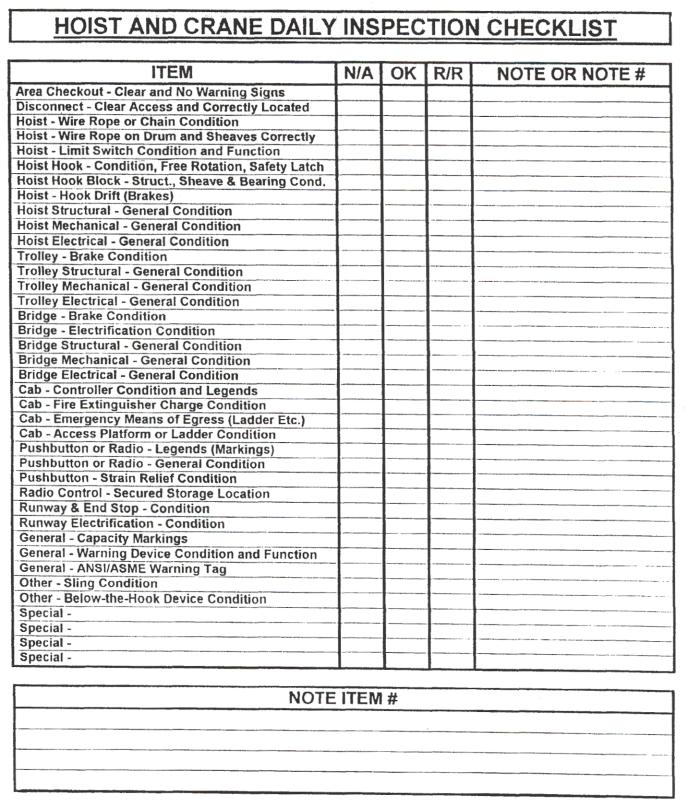
You are welcome to download and print this checklist for your own reference at: www.cranetraining.ca/dailychecklist.pdf

Daily Inspection

a. Hoists and cranes shall be inspected for loose parts. Oil leaks and other defects on a daily basis. Any defect or unsafe condition observed shall be reported to the supervisor immediately.

b. Hoist and crane controls shall be kept clean and functional at all times. and should be thoroughly tested to ensure their proper operation.

c. All slings and ropes shall be inspected for wear and damage. If fraying is evident, they shall be destroyed and replaced immediately.  Hooks shall be inspected for stretching “metal fatigue” and the presence of a safety latch.

Maintenance

a. A designated worker shall lubricate working and moving parts of the crane. During this process the crane shall be properly locked and tagged out to ensure that the crane does not accidentally start.

b. Operators shall not tie in, block or otherwise make inoperative, any circuit breaker, limit switch or other safety device.

c. Ensure that no employees are in the area of operation when testing cranes.

d. A sign should be posted during maintenance work.